Monday, October 1, 2012

English, French and Italian Theater

     During the late 16th and throughout the 17th century, English theater developed significant differences that helped distinguish it from French and Italian theater. English theater was more free from the grasp of tyrannic monarchy, since it became a product of the Reformation. William Shakespeare's literary works of art also contributed to theater with its obvious examples being Romeo and Juliet and Midsummer Nights Dream. During the 17th century century, Italian drama was more of a company controlled by the majestic authority of the country, but it also had the aspect of tragedies and comedies. Another difference between French/ Italian and English theater is that the theater of England during this time period was sought after not only in the form of a play, but also in its literary textual form. On the contrary, French and Italian theatrical writings have virtually no popular history while the performances of those writings are extremely famous amongst theater fanatics. Additionally, French theater did not prohibit women from any roles on stage while English theater did, but the separation of Church and theater in England really differed from the way things were ran religiously in France and Italy.

A scene from the Romeo and Juliet movie from the 20th century, perhaps the most famous play ever written
http://www.don-juan.net/english/italie/li17mod03set.htm

Saturday, September 22, 2012

    In Euripides ancient play of Medea, a common theme of alienation and vengeance is conveyed. Medea, a barbaric Greek woman, is betrayed by her husband Jason, who abandons her to marry the royal daughter of King Creon. This series of unfortunate events thrusts Medea into a state of deep anger in which she vows to gain revenge. At first, my response to Medea is one of sympathy and sorrow, especially when she pleads with King Creon to give her an extra day of freedom before her exile. Another passage from the play where my feelings towards Medea are those of sympathy is when she offers to help Aegeus, King of Athens with conceiving a child in return for protection. However, these sentiments of sorrow are no longer present in my judgement of Medea when she plots to cleverly kill Jason and his new wife Glauce, along with her very own children. The offer to help Aegeus was merely a sly way of having a safe haven to reside in after she murdered so many people. Ultimately, when she kills Glauce,  Creon and lastly her children, I can only have feelings of disgust for Medea. Her actions are extremely brutal and counterproductive; one can still feel sad for her because, after all, she is still a barbarian women who doesn't know any better and has been the victim to a serious betrayal.
    The ending of Medea escaping to Athens on a chariot pulled by dragons can be interpreted in many ways. I believe that Euripides portrayed the ending in this manner to suggest her might and strength as a Greek woman. Additionally, the dragons represent utmost power and might which can suggest that the actions committed by Jason were unjust and that Medea deserved better. Escaping with the murder of her children can show that even though what she did was an awful deed, she did not bring it upon herself.
Medea

Monday, September 17, 2012

Japanese vs Medieval Theater

    The roots of Japanese and Medieval theater were significantly different; both the Skaldic form of theater and Bugaku attempt to honor and reenact the stories of warriors and heroes. However, the way they go about in portraying these themes is significantly different. Japanese forms of theater such as Bugaku implement slow and graceful movement to convey its messages while on the other hand a Skaldic play incorporates a poet as the narrator to a violent and heroic storyline. Additionally, Skaldic performances lacked Christian influence, as they were mainly an aristocratic art. Medieval forms of theater such as the Tegernsee Passion Play of 1180 also carry heavy political themes of church versus state while Japanese forms of theater such as Noh focus primarily on depicting ghosts, spirits, and other mystic themes not relating to religion. Medieval theater of Europe eventually came to a decline mainly due to the repercussions of religious/political influence, in this case the effect of the Protestant Reformation. On the contrary, theater in Japan seldom suffered from this sort of backlash due to its long time history as being free of religion.

Above is a picture of a typical Bugaku mask. Japanese theater heavily implemented the usage of masks and cosmetics.


Medieval Theater...

Friday, September 7, 2012

Differences between Ancient Green and Roman Theater

    Although much of Roman theater is influenced by Ancient Greek theater, they share a few significant differences that help distinguish Greek theater from Roman theater. For example, Greek performers were usually aristocrats that were high class members of society; theater in ancient Greece had evolved as a way to educate the masses about its history. On the contrary, the Romans utilized poor men, often slaves, as their performers in various forms of theater than included plays derived from literature, tragic dramas, comedies and the notorious gladiator battles. Greek theater also consisted of dramas and tragedies but their primary focus was to convey the history of their peoples, namely the history of major wars.
    In a sense, Greek theater was implemented as a form of education and enlightenment while the Romans were concerned with organizing magnificent, large scale performances that reflected upon their imperial valor.

http://depthome.brooklyn.cuny.edu/classics/dunkle/comedy/romnthtr.htm

Thursday, August 30, 2012

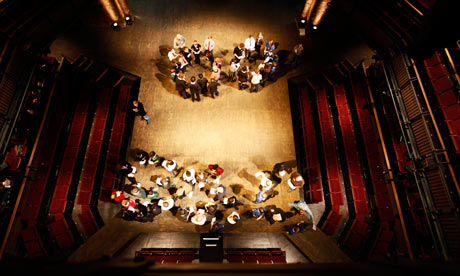
    The most common type of theater spacial configuration is proscenium, in which the audience has the opportunity to view the play as a whole and obtain the most visual and audial entertainment. The distance between the performers and the audience in a proscenium theater is vastly greater than the distance of a thrust configuration; this allows for greater scenic depth and detail but limits the intimate relationship that is possible with the thrust stage. Lastly, the arena form of spacial configuration offers its own unique aspect of theater where physical performance is emphasized over anything else. In a sense, the advantages of a certain form of spacial configuration are the disadvantages of another form and vice versa.
    For example, the picture below is the completed renovation of the Royal Shakespeare Company theater that is located in the hometown of legendary playwright William Shakespeare. A link to the article and picture suggests that audience members were becoming weary of the inaudible voices from the performers. Although a proscenium offers a much more scenic view that contributes to grander scale of theater, a thrust such as the one below can allow for deeper interaction between the audience and performance. A similar affect can be achieved from an in the round arena.


An aerial view of a thrust stage at the Royal Shakespeare Theater in Stratford-upon-Avon